Imagine this: You’ve just received a quotation for your dream kitchen. One contractor quotes RM250 per foot run for quartz, but another offers “Premium Quartz” for only RM70. It looks the same, feels the same, and the salesperson promises it’s just as durable.
The Malaysian market is seeing a surge in compressed marble being fraudulently sold as quartz stone. To the untrained eye, they are nearly identical. But while real quartz is a lab-engineered tank built for heavy cooking, compressed marble is a fragile beauty queen that will stain, etch, and crack the moment you start using your kitchen like a real Malaysian home.
Here is everything you need to know to protect your investment and spot the scam before it’s too late.
What is Compressed Marble?
Compressed marble (often marketed as engineered marble or reconstituted stone) is a man-made product that aims to give you the high-end look of luxury marble at a fraction of the cost. However, its DNA is completely different from the quartz it often pretends to be.
Compressed Marble Ingredients: Recycling the Scraps
While quartz is made from one of the hardest minerals on Earth, compressed marble is essentially a recycled stone.
It is made by taking the by-products of marble mining, such as crushed marble chips, stone gravel, and fine marble dust, and mixing them with polyester resins and pigments. This mixture is poured into large moulds and compressed under high pressure to form a solid slab.
The final product looks stunning, featuring the elegant veins and smooth, cool touch of natural marble.
Fatal Flaw: Calcium Carbonate
This is the scientific reason why compressed marble is a “danger” in the kitchen. Because its primary ingredient is marble, it consists mostly of calcium carbonate.
Calcium carbonate is highly reactive to acids. In a lab, this is a cool experiment; in your kitchen, it’s a disaster. Even a single drop of asam jawa (tamarind), limau kasturi (calamansi), or even the condensation from a soda can will cause acid etching.
This isn’t a stain that can be washed off. It is a permanent chemical corrosion that eats away the stone’s surface, leaving a dull, white, etched mark that permanently ruins the finish.
Why is Compressed Marble Called an Imposter?
The term “engineered stone” is often used loosely in Malaysia. Dishonest sellers use the phrase “engineered stone” to make you think you are buying quartz. While both are engineered, they are worlds apart in performance.
Quartz is engineered for durability (7 on the Mohs Scale) while compressed marble is engineered for aesthetics (3 on the Mohs Scale).
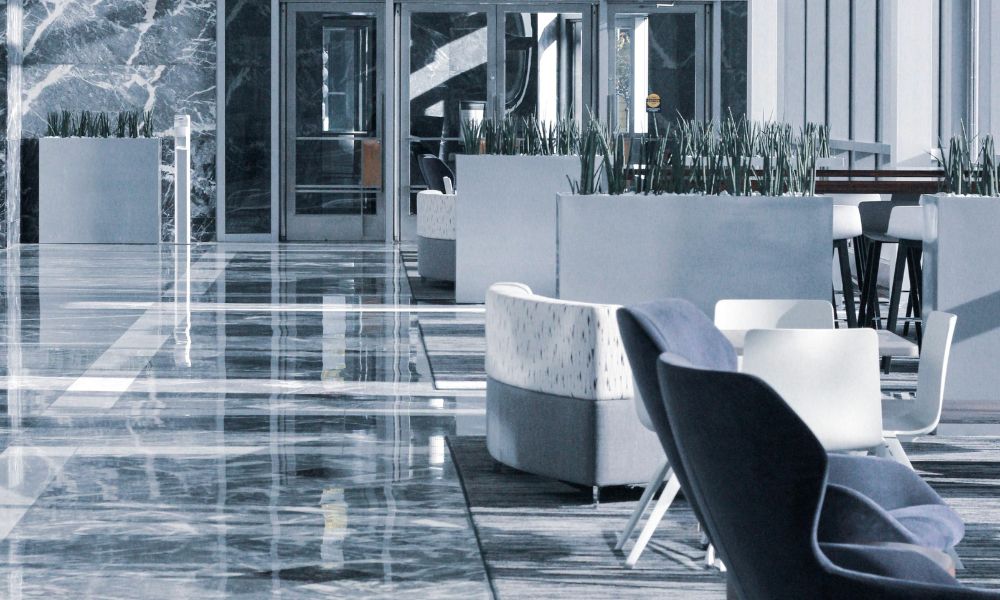
Compressed marble is a fantastic, eco-friendly material for low-traffic areas like hotel lobbies, bathroom vanities, or wall features. But the moment it is sold as a kitchen countertop option to a Malaysian home chef, it becomes a scam. It simply cannot survive the acid, heat, and impact of a real kitchen.
The Anatomy of Quartz: What’s Inside?
Engineered quartz is a composite material, typically following the Bretonstone patent, which is the gold standard for stone manufacturing worldwide.
The 93/7 Rule
Most premium quartz slabs (like Silestone or Caesarstone) follow a specific ratio of 93% natural quartz aggregates and 7% polymer resins and pigments.
The 93% are real quartz minerals extracted from the earth, crushed into various sizes (from fine powder to 3mm granules). This provides the stone-like hardness.
The 7% polymer resins and pigments are the glue (usually polyester resin) that binds the minerals together. It fills every microscopic gap, making the slab 100% non-porous.
The No-Seal Advantage
Unlike granite or marble, quartz never needs to be sealed. Natural stone has tiny veins and pores that act like sponges, soaking up water and harbouring bacteria. Because the resin in quartz fills these pores, it is naturally antimicrobial, making it one of the most hygienic surfaces for a family kitchen.
Chemical & Acid Resistance
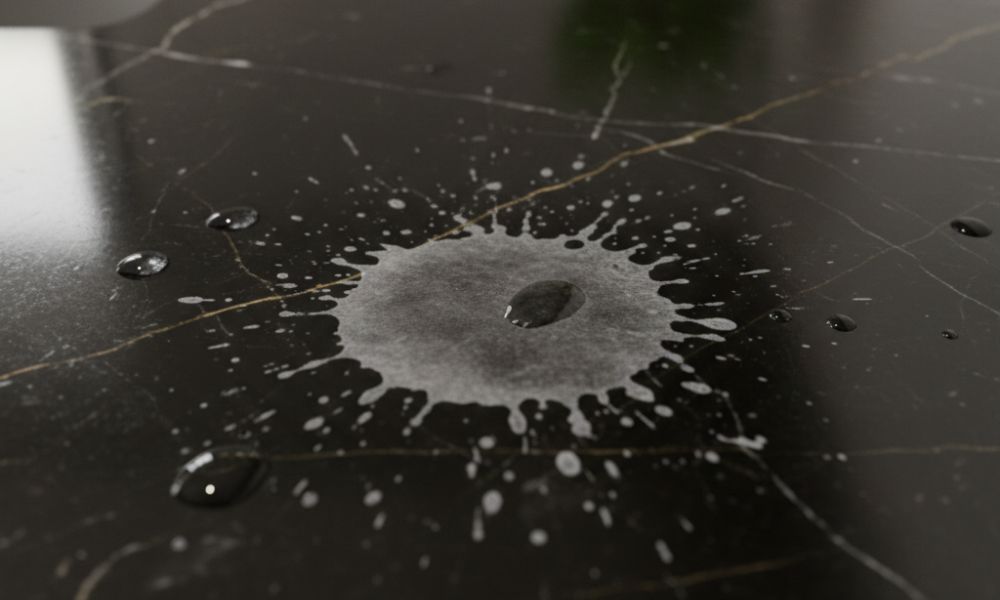
Natural stones like marble are made of calcium carbonate, which reacts to acids (like asam jawa or vinegar). If you spill lime juice on marble, it etches (eats away) the surface instantly. Quartz is acid-resistant, meaning your citrus juices and vinegar won’t leave a permanent dull spot.
Why Scammers Sell Compressed Marble as Quartz
In the Malaysian renovation industry, the temptation to substitute materials is driven by one thing: Extreme profit margins. To a dishonest contractor, your kitchen island isn’t just a design feature, it is an opportunity to pocket thousands of Ringgits in hidden profit.
The Massive Price Gap
The price difference between these two materials in Malaysia is staggering.
A contractor can source low-grade compressed marble for as little as RM40 to RM80 per foot run. Conversely, authentic, high-quality quartz slabs typically cost the contractor between RM130 to RM220 per foot run (before labour and fabrication).
By quoting you a “special price” of RM150 for “quartz” but installing RM50 compressed marble instead, the scammer effectively triples their profit on the material alone. For a standard 15-foot kitchen, this “Switcheroo” can net the contractor an extra RM1,500 to RM2,500 in pure, untaxed profit at your expense.
The Unbelievable Quote Trap
Scammers often target homeowners who are shopping for the lowest price. They know that if they provide a quote at the fair market rate (RM200+), they might lose the job. Instead, they lure you in with a too-good-to-be-true price.
They use high-end photos of real quartz on their tablets or brochures but deliver the imposter slab to your house on installation day. Even if you notice a difference, they will often blame batch variations or lighting in the warehouse. They are betting on the fact that once the stone is glued down, you won’t ask them to rip it out.
Capitalizing on Lack of Knowledge
Most Malaysian homeowners know that quartz is good, but very few know why. Scammers exploit this lack of technical knowledge by using vague terms like “engineered stone”, “synthetic marble”, or “quartz-grade marble”. These terms have no legal standing in the stone industry and are specifically designed to confuse you into thinking you are getting the durable product you asked for.
The Quick Exit Strategy
Because compressed marble looks beautiful when first installed, the scam is often invisible for the first 3 to 6 months. By the time your countertop starts to etch, stain, or lose its shine, the fly-by-night contractor has already:
- Collected the final 10% payment.
- Closed their temporary Facebook page or changed their WhatsApp number.
- Left you with no warranty and a surface that needs a total replacement.
Under the Malaysian Consumer Protection Act 1999, providing a “false or misleading representation” regarding the quality or grade of a product is an offense. However, catching these scammers after they vanish is nearly impossible. Prevention is your only real defence.
Scam Spotter Tests: How to Verify Your Stone
If you are at a showroom or looking at a sample, use these three proven tests to verify the material.
Test A: White Vinegar Acid Test (The Most Reliable)
Marble reacts to acid. Quartz does not.
Drop a small amount of white vinegar or lemon juice onto a raw (unpolished) edge or the back of the slab. If it starts to fizz, bubble, or leave a dull spot after a few minutes, it is compressed marble. Real quartz will show zero reaction.
Test B: Flashlight Depth Test
Shine your phone’s flashlight about 6 inches from the surface. Since quartz is 90% natural crystal, you should see depth. The light will catch individual crystals at different layers.
If it is compressed marble, it will look flat and opaque. The pattern looks like it’s printed on a solid, chalky background.
Test C: The Knife Scratch Test
Real quartz Scores a 7 on the Mohs Hardness Scale. It is harder than steel. If you try to scratch the underside with a sharp knife, the knife should leave a metal mark (like a pencil) rather than gouging the stone.
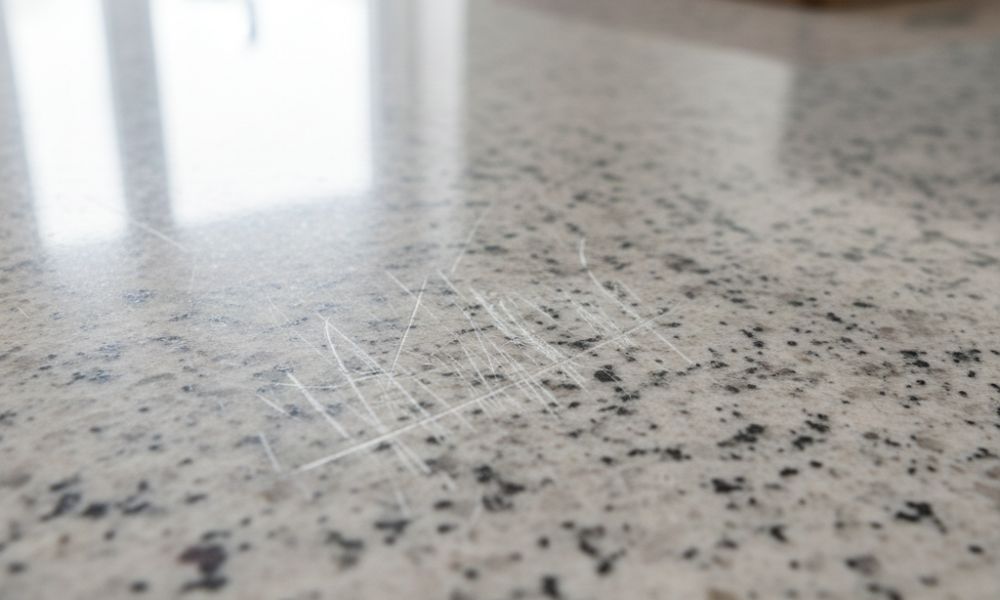
Compressed marble scores a 3 on the Mohs Scale. It is soft. A steel knife will easily leave a permanent, deep scratch in the material.
Red Flags in the Quotation
If you see these signs in your contractor’s proposal, walk away:
- Authentic quartz rarely falls below RM150 per foot run (installed). If you see quartz for RM60 – RM90, it is almost certainly compressed marble.
- Look for terms like “engineered stone” or “synthetic marble” used interchangeably with quartz. A reputable supplier will be specific.
- Genuine quartz suppliers in Malaysia (like Caesarstone, Silestone, or reputable local brands) provide a certificate of authenticity. If the contractor says it’s unbranded factory direct, be extremely cautious.
What Happens if You Buy the Scam?
If you unknowingly installed compressed marble in your wet kitchen, there will be signs.
- Turmeric will bleed into the pores within minutes, leaving a permanent yellow stain that no amount of Cif can remove.
- Placing a rice cooker or air fryer directly on the surface can cause the slab to warp or develop burn rings because the resin content in low-grade marble composites is much higher (and cheaper) than in quartz.
- Within 12 months, the high-gloss shine will vanish from the high-traffic areas, leaving your kitchen looking old and worn.
Conclusion: Buy Once, Buy Right
A kitchen renovation is a 10-to-20-year investment. Saving RM1,000 today by opting for a too-good-to-be-true deal can result in a RM10,000 bill to rip out and replace your countertops in two years.
Be a smart consumer and don’t get scammed. At Aurastone, we provide 100% authentic, certified quartz and sintered stone. Every slab is tested for acid resistance and hardness before it leaves our warehouse.