
You’ve spent months choosing tiles, fittings, and cabinet finishes. You’ve compared quartz and sintered stone, debated polished versus honed, and finally locked in a budget. But here’s the question almost no Malaysian homeowner thinks to ask: is your countertop releasing chemicals into the air your family breathes?
It sounds dramatic. But it’s a legitimate concern – especially in Malaysian kitchens, where wet kitchens are enclosed, wok cooking generates sustained heat, and air circulation is often limited. The surface on your countertop is in daily contact with your food, your steam, and your family.
This is exactly why GREENGUARD Gold certification exists – and why Mysa, Aurastone Malaysia’s sintered stone range, holds it. This article explains what GREENGUARD Gold is, how it’s awarded, why most countertops in Malaysian homes don’t carry it, and what it actually means for the safety of your kitchen.
What Is GREENGUARD Gold Certification?
GREENGUARD Gold is the most stringent indoor air quality certification in the world for building materials and furnishings. It is issued by UL – Underwriters Laboratories – and limits over 360 volatile organic compounds (VOCs) and chemical emissions to protect human health in enclosed spaces.
UL is the same independent safety science organisation that certifies electrical appliances and fire-rated materials globally. GREENGUARD is their indoor air quality programme, first developed in the early 2000s to address rising concerns about chemical off-gassing from building materials. GREENGUARD Gold – formerly called GREENGUARD Children & Schools – applies the strictest emission thresholds within the programme: limits designed to protect children in schools and patients in hospitals.
When a building product earns GREENGUARD Gold certification, it means an independent laboratory has tested that specific product and confirmed that its VOC emissions fall below the most demanding safety thresholds available. It is not a manufacturer claim. It is not a self-assessment. It is third-party verification.
For full details on how GREENGUARD certification works, UL publishes its methodology publicly.
Why Does Indoor Air Quality Matter for a Kitchen Countertop?
Kitchen surfaces are in daily contact with food, steam, and sustained heat. A GREENGUARD Gold certified surface confirms that the material emits no harmful chemicals into indoor air – even under the conditions of active cooking.
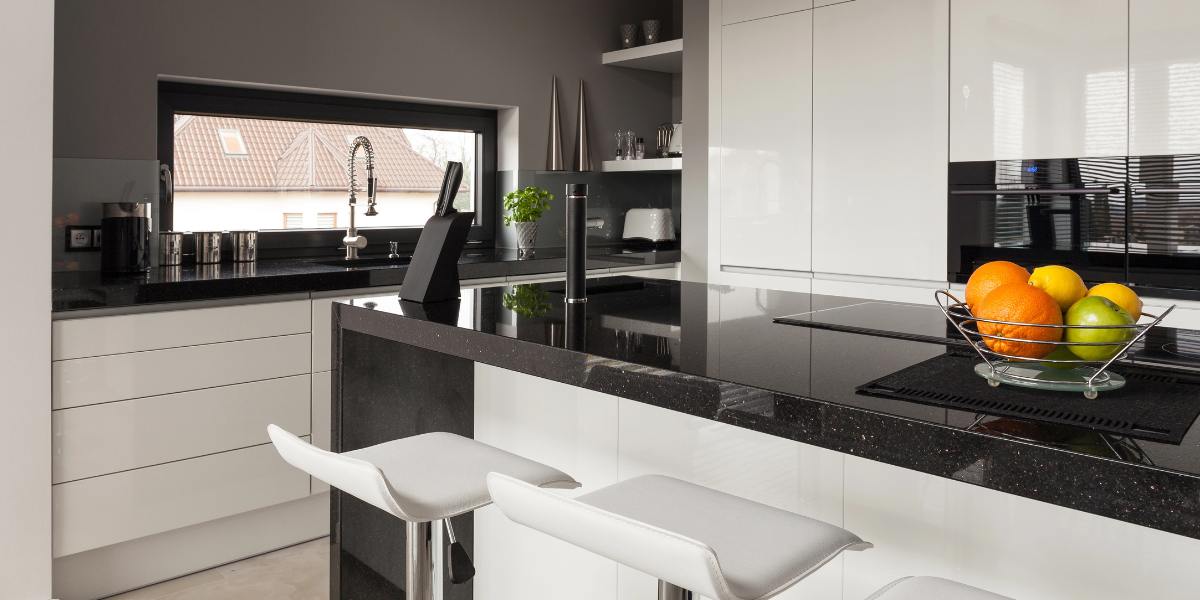
Most homeowners think about what a countertop does to food – will it stain, scratch, or harbour bacteria? Fewer think about what a countertop releases into the air. But VOCs – volatile organic compounds – are chemicals that evaporate at room temperature from certain materials and enter the indoor air supply. Over time, in an enclosed space, they accumulate.
This matters more in a Malaysian kitchen than almost anywhere else. Wet kitchens in condos and landed homes – particularly in developments across Iskandar Puteri — are typically enclosed rooms with limited cross-ventilation. Wok cooking produces sustained heat contact with the countertop surface, which can accelerate any off-gassing from resin-based materials. And Malaysian families cook frequently – this isn’t a kitchen that gets used twice a week. It’s a kitchen that works hard every day.
GREENGUARD Gold certification means the surface has been tested for emissions under conditions that simulate real indoor use – not just at room temperature in a laboratory setting.
Why Doesn’t Standard Quartz Carry GREENGUARD Gold Certification?
Most quartz countertops are manufactured with 7–10% polymer resin binder, which holds the engineered stone together. Resins can emit VOCs into indoor air over time — particularly in warm, enclosed environments. This makes GREENGUARD Gold certification significantly harder for resin-based surfaces to achieve.
Quartz countertops are engineered stone: typically 90–93% ground quartz crystals combined with polymer resins, pigments, and sometimes glass or mirror fragments. The resin is structural – without it, the slab would not hold together. But resin chemistry is also where the VOC risk originates. Not all resins are equal, and well-manufactured quartz from reputable brands is formulated to minimise off-gassing. But the presence of resin means the VOC question is always relevant.
Sintered stone – including Aurastone’s Mysa- is manufactured through an entirely different process. Raw mineral powders are compressed under extreme pressure and fired at temperatures up to 1,200°C. No resin is added. No binder is required. The minerals fuse at a molecular level through heat and pressure alone, producing a surface that is chemically inert. There is nothing in the material composition that can off-gas.
This is why GREENGUARD Gold certification is achievable for sintered stone in a way that is structurally more difficult for standard engineered quartz. It is not a matter of quality – it is a matter of material chemistry.
What Does GREENGUARD Gold Certification Mean for Mysa by Nabel Specifically?
Mysa by Nabel holds GREENGUARD Gold certification issued by UL, confirming that its sintered stone slabs meet the most stringent indoor air quality standards for VOC emissions – independently verified, not self-declared.
This matters because ‘safe’ and ‘certified safe’ are meaningfully different things. Any supplier can describe their product as low-emission or family-friendly. GREENGUARD Gold means a third party has tested the specific product, checked the chemistry, and issued a certificate to confirm it. The certification is tied to Mysa’s actual slab composition – not to the category of sintered stone in general.
In practice, this means:
- Mysa sintered stone emits VOCs below the strictest threshold limits defined by UL
- The certification applies to slabs as they are sold and installed in Malaysian homes
- The certificate can be provided on request – it is a verifiable document, not a marketing statement
When paired with Mysa’s other material properties – non-porous (no bacterial growth), anti-microbial, food-safe, and rated 7 on the Mohs hardness scale – GREENGUARD Gold is the certification that validates the ‘safe for family cooking’ claim at a chemical level, not just a surface level.
If you are specifying or purchasing a countertop and your supplier makes a safety or low-emission claim, ask for the UL certificate. If they cannot produce one, the claim is unverified.

Does GREENGUARD Gold Matter for Green Building Projects in Malaysia?
Yes. Malaysia’s Green Building Index (GBI) and internationally recognised LEED standards both require documented evidence of low-emission materials for certified projects. GREENGUARD Gold certification satisfies those requirements for countertop and surface finishes.
For interior designers and architects specifying surfaces for developer projects in Johor Bahru and the Klang Valley, this has practical implications. GBI-rated residential and commercial developments must demonstrate that interior materials meet indoor air quality standards. GREENGUARD Gold is widely recognised as evidence of compliance. It simplifies the specification and documentation process considerably.
For homeowners in non-rated developments, this is still relevant. Green building awareness is growing among Malaysian buyers, particularly in the T20 segment. Choosing GREENGUARD Gold certified materials is a way to make a verifiable, evidence-backed decision about indoor air quality – not just a values statement.
For reference on Malaysian construction and material standards, the Construction Industry Development Board Malaysia (CIDB) publishes relevant guidelines and compliance frameworks.
How Do You Verify a Countertop’s GREENGUARD Gold Status?
Ask your supplier for the GREENGUARD Gold certificate issued by UL. The certificate names the specific product, the certifying body, and the certification number. It is also publicly searchable on UL’s Product iQ database.
This is a simple but effective filter when comparing suppliers. A genuine GREENGUARD Gold certificate will name UL as the issuing body, identify the specific product or product range, and carry a certificate number you can cross-reference. A supplier who cannot produce this document — or who claims ‘GREENGUARD certified’ without specifying Gold – is not making an equivalent claim.
It is worth being precise: GREENGUARD and GREENGUARD Gold are two different tiers. Standard GREENGUARD applies general emission limits. GREENGUARD Gold applies the stricter children’s environment limits. For a kitchen surface in daily contact with food and family, Gold is the standard that matters.
Aurastone’s team can provide Mysa’s GREENGUARD Gold documentation alongside your RM quote. It is not a document kept in the back office – it is a standard part of the specification package for any client who asks.
If you are weighing up sintered stone for your kitchen and want to see Mysa by Nabel in person, our Johor showroom has the slabs, the finish samples, and the certification paperwork ready. We can walk you through the heat, stain and UV tests, and put a transparent RM price in front of you before you commit. Drop by, or WhatsApp our team to arrange a time that works.
Frequently Asked Questions
What is GREENGUARD Gold certification?
GREENGUARD Gold is an indoor air quality certification issued by UL (Underwriters Laboratories) that limits over 360 VOCs and chemical emissions from building materials. It applies the strictest emission thresholds within the GREENGUARD programme – the same limits used to protect children in schools and patients in hospitals. It is independently tested and third-party verified, not a manufacturer self-declaration.
Is Aurastone’s Mysa sintered stone GREENGUARD Gold certified?
Yes. Mysa by Nabel holds GREENGUARD Gold certification issued by UL. This confirms that Mysa sintered stone slabs meet the most stringent indoor air quality standards for VOC emissions. The certificate is available on request from Aurastone Malaysia.
Does quartz countertop have GREENGUARD Gold certification?
Most standard quartz countertops contain 7–10% polymer resin binder, which can emit VOCs and makes achieving GREENGUARD Gold certification more difficult. Some premium quartz brands have pursued GREENGUARD certification – but not all, and not always at Gold level. Always ask for the specific UL certificate when a supplier makes a low-emission claim.
Why does GREENGUARD Gold matter in a Malaysian kitchen specifically?
Malaysian wet kitchens are typically enclosed with limited ventilation, and wok cooking creates sustained high-heat contact with countertop surfaces. Both conditions can accelerate VOC off-gassing from resin-based materials. A GREENGUARD Gold certified surface – like Mysa by Nabel – has been independently tested to confirm its emissions remain below safe thresholds even under real indoor conditions.
How do I check if a countertop is genuinely GREENGUARD Gold certified?
Ask your supplier for the UL-issued GREENGUARD Gold certificate for the specific product. The certificate will name UL as the issuing body, identify the product, and carry a verifiable certificate number. You can also cross-reference certificates on UL’s Product iQ database. If a supplier cannot produce this document, the certification claim is unverified.