
In Malaysia, the dream of owning a home is often followed by the daunting reality of the renovation phase. Whether you’ve just collected the keys to a new condo in Mont Kiara or are looking to refurbish a heritage terrace house in Petaling Jaya, you are immediately faced with the million-ringgit question: Should I hire an interior designer or a contractor?
The decision isn’t just about aesthetic. It’s about your budget, your sanity, and the longevity of your home. In a market where renovation horror stories are common dinner-party conversations, choosing the right professional is the difference between a dream kitchen and a leaky nightmare.
At Aurastone, we’ve seen thousands of renovations across Malaysia. We know that while a beautiful quartz countertop or a leakproof Aurasink is the finishing touch, the foundation of a successful renovation lies in who is managing the project.
In this guide, let’s break down the pros and cons of interior designers and contractors to help you decide which path fits your lifestyle.
What Does an Interior Designer (ID) Actually Do?
Many Malaysians mistake an interior designer for someone who just picks out curtains. In reality, a professional ID firm provides a comprehensive service that includes space planning, 3D rendering, and site supervision.

When you hire an ID in Malaysia, you are paying for a concept. They ensure that your dry kitchen flows seamlessly into your living area and that your lighting plan matches your furniture layout. Most importantly, they act as the single point of contact. If the carpentry is delayed or the tiler makes a mistake, it is the ID’s job to fix it, not yours.
What Does a Main Contractor Do?
A main contractor is the builder. They are the experts in execution such as hacking, tiling, plumbing, and electrical work. In Malaysia, many homeowners choose to go direct to contractor to save on professional fees.

A contractor typically works based on your instructions. If you tell them to install a kitchen island, they will build it to your dimensions. However, they usually won’t tell you if the island is too big for the walkway or if the colour clashes with your floor tiles. They are the masters of how to build, but not necessarily what to design.
The Comparison Matrix: Breaking Down the Real Costs
When Malaysians talk about renovation, the first question is always: How much?
While a contractor may seem cheaper on paper, the true cost of a renovation isn’t just the final invoice. It’s the value of your time.
Fee Structures: The 10% vs 30% Gap
If you decide to take the contractor route, you will save on professional fees, but you are effectively the CEO of the site. A general contractor typically adds a 10% – 15% management fee to coordinate their sub-contractors.
However, if you engage an ID firm, they generally charge a design fee (ranging from RM3 to RM10 per sq. ft.) or a project management fee of 15% – 30% of the total renovation cost. It may be more expensive, but at least you are paying a premium for 3D visualizations and peace of mind.
The Hidden Costs of DIY Management
Hiring a contractor directly is a popular money-saving move, but it often leads to hidden expenses. Without an ID’s precise measurements, you might over-order tiles or under-order cabinet laminates.
Furthermore, an ID usually has fixed panels of artisans and suppliers that they trust, whereas a random contractor might hire cheaper, unskilled labour to stay competitive.
The Kitchen Heart: Bridging Design and Durability
Whether you choose an ID to curate a Pinterest-perfect mood board or a contractor to execute a high-performance kitchen, both must align on the countertop and sink.
In Malaysia, where heavy cooking (and the occasional turmeric stain!) is part of our daily culture, the kitchen takes more abuse than any other room.
The ID’s Perspective: Aesthetics
An ID will likely suggest Aurastone sintered stone or quartz because of the design flexibility. From book-matched veins for a luxury island to matching the backsplash with the countertop for a minimalist silhouette, Aurastone provides the look and feel that an ID needs to win awards.
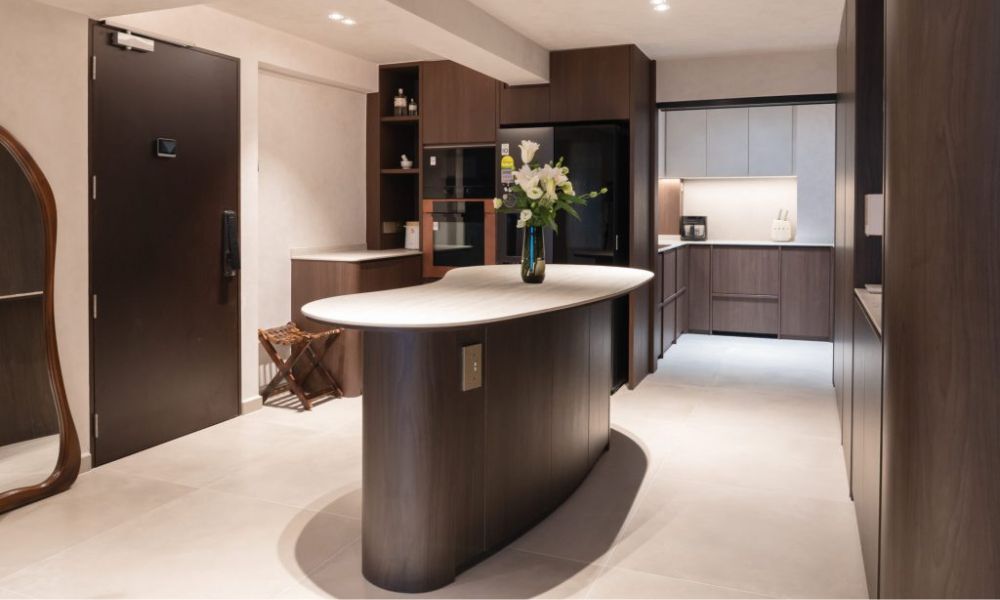
The Contractor’s Perspective: Technical Integrity
A contractor is worried about callbacks. They hate it when a homeowner calls six months later complaining about water damage under the sink. This is why contractors appreciate the Aurasink.
Traditional undermount sinks in Malaysia often rely solely on silicone, which eventually erodes in our humid climate, leading to rotten cabinet syndrome. The Aurasink solves this with its leak-proof ridge design and customized clamping system. It ensures the sink stays securely bonded to the Aurastone slab, no matter how many heavy pots and pans you wash.
Crucial Local Factors: Navigating the Malaysian Maze
In Malaysia, a renovation involves local councils, management offices, and your neighbours.
The Majlis Perbandaran Approval (DBKL, MBPJ, and Others)
Many homeowners assume that because they own the house, they can hack any wall they like. However, if you are planning an extension (like the classic Malaysian backyard wet kitchen extension), you legally require a renovation permit from your local council.
If this is a hassle, we suggest you get the ID advantage. Most ID firms act as a one-stop-shop and will handle the submission to the council on your behalf. They work with registered architects to ensure your plans meet the Uniform Building By-Laws (UBBL).
But if you choose to engage a contractor, typically, they will expect you to provide the approved permit. If you go this route, look into Pelan Setara (Standard Plans) offered by councils like MBPJ or MBSJ. These are pre-approved templates for terrace house extensions that can save you upwards of RM2,000 in professional fees.
Strata Living and Management Offices
If you live in a condo or a gated-and-guarded community with a strata title, the rules are even stricter. Most Malaysian condos only allow loud works between 9:00 AM and 5:00 PM on weekdays, and a total ban on weekends and public holidays.
This is where a good contractor shines. They are the ones who have to coordinate the lorry deliveries, protect the common lifts with canvas, and manage the debris out schedule. While an ID manages the plan, the contractor manages the security guard at the gate, a relationship that can make or break your timeline.
Before any renovation can start, expect to pay a refundable deposit of RM2,000 to RM5,000 to your condo or strata Management Office.
The Neighbour Factor
In Malaysia, the biggest cause of “Stop Work Orders” isn’t the council. It’s usually an angry neighbour who has to tolerate the dust and noise.

Before you start, buy a few boxes of pisang goreng or donuts and visit your immediate neighbours. Tell them you’re renovating and give them your contractor’s number.
If you are installing stone surfaces, the professional installers use wet-cutting or dust-extraction tools to minimize the mess, but traditional hacking for tiles is incredibly dusty. Ensure your contractor uses proper plastic hoarding to keep the dust from drifting into your neighbour’s porch.
Interior Designer vs Contractor – Which One Should You Choose?
Choose an interior designer if you are a busy professional, you’re tackling a major gut renovation, or you want a cohesive, magazine-worthy aesthetic. You are paying for their vision and their time.
Choose a contractor if you have a clear vision of what you want, you enjoy being hands-on, and you want to keep costs to a minimum.
Regardless of who you hire, the quality of your materials is what you will live with every day. A beautiful design can be ruined by a leaky sink, and a cheap contractor’s work can be elevated by a premium Aurastone surface.